
Contents
Introduction
Have you ever wondered why some metal tools stay sharp forever while others get dull quickly? Or why certain gears in a car engine can spin millions of times without breaking? The secret often lies in a special process called surface hardening. It is like putting a super-strong shield around a softer metal core. This helps the metal handle a lot of wear and tear without snapping in half. Think of it like a hard candy shell on a piece of chocolate. The outside is crunchy and tough, but the inside stays soft and chewy. In the world of metalworking, this combination is exactly what engineers want.
Surface hardening is a very popular technique used in factories all over the world. It allows manufacturers to make parts that are extremely durable on the outside but still tough and flexible on the inside. If the whole part were hard, it might shatter like glass when hit. If the whole part were soft, it would wear down too fast. By using surface hardening, we get the best of both worlds. This guide will walk you through exactly how this works, why it is so important, and the different ways people do it. We will keep things simple so you can understand the magic behind strong metals.
What Is Surface Hardening Exactly?
So, what do we mean when we say surface hardening? Simply put, it is a type of heat treatment. Heat treatment is when we heat metal up and cool it down to change how it acts. With surface hardening, we only change the outer layer of the metal. The core, or the middle of the part, stays the same. This is crucial for parts that need to resist scratching or rubbing but also need to handle heavy loads.
Imagine an armored truck. The outside is covered in thick, hard plates to stop bullets. But the frame of the truck needs to be flexible enough to drive over bumps without cracking. Surface hardening does the same thing for metal parts. It creates a “case” or a hard skin. This skin might only be a fraction of a millimeter thick, or it could be deeper depending on what the part needs. The goal is always to improve wear resistance without making the part brittle.
Why Do We Need Surface Hardening?
You might ask, “Why not just make the whole thing out of super hard metal?” Well, very hard metal has a weakness. It tends to be brittle. That means if you hit it with a hammer, it might crack or shatter. Most machine parts, like gears or axles, experience a lot of shock and vibration. They need to be able to absorb that energy. A softer, tougher core helps absorb that shock. But if the surface is soft, it will get scratched and worn away very quickly.
This is where surface hardening saves the day. It gives us a hard surface to stop wear and a tough core to stop breaking. This extends the life of the part significantly. Instead of replacing a gear every month, you might only need to replace it every few years. This saves companies a lot of money and time. It also makes machines safer because parts are less likely to fail suddenly. From kitchen knives to giant construction cranes, surface hardening is everywhere.
The Case Hardening Method: Carburizing
One of the most common ways to achieve surface hardening is called carburizing. This method is all about adding extra carbon to the surface of the steel. Steel is made of iron and carbon. Generally, the more carbon you have, the harder the steel can get. In carburizing, we take a piece of low-carbon steel (which is soft) and put it in a furnace filled with carbon-rich gas or powder. We heat it up very hot, usually around 1700°F.
At this high temperature, the steel acts like a sponge. It soaks up the carbon atoms into its surface. After it has soaked up enough carbon, we cool it down quickly, usually by dunking it in oil or water. This rapid cooling locks the carbon in place and makes the surface extremely hard. The core, which didn’t get the extra carbon, stays soft and tough. This is a classic method for making things like gears and piston pins.
Another Approach: Nitriding
Nitriding is another popular way to do surface hardening. It is a little different from carburizing because it uses nitrogen instead of carbon. In this process, we heat the steel to a lower temperature, usually around 950°F. We put it in an environment filled with nitrogen, often using ammonia gas. The nitrogen atoms diffuse, or spread, into the surface of the metal.
The cool thing about nitriding is that you don’t always need to cool the part down quickly like you do with carburizing. This means the metal is less likely to warp or change shape. Because of this, nitriding is great for parts that need to be very precise, like precision gears or fuel injection parts. It creates a very hard, thin layer that is also great at resisting corrosion and rust. If you need a part that stays the exact right shape, nitriding is often the best choice.
Using Fire: Flame Hardening
Sometimes, you don’t need to add chemicals like carbon or nitrogen. You just need heat. Flame hardening is a very direct method of surface hardening. As the name suggests, we use a high-temperature flame to heat up the surface of the metal part very quickly. The flame is usually fueled by oxygen and gas, like acetylene. We blast the surface until it gets red hot.
Once the surface is hot enough, we immediately spray it with water to cool it down fast. This rapid cooling, called quenching, hardens the steel instantly. Flame hardening is awesome for really big parts. Imagine a huge gear for a bridge or a massive roller for a steel mill. You can’t fit those in a standard furnace. With a flame, you can just treat the specific area that needs to be hard. It is a flexible and cost-effective way to get the job done on large equipment.
Using Electricity: Induction Hardening
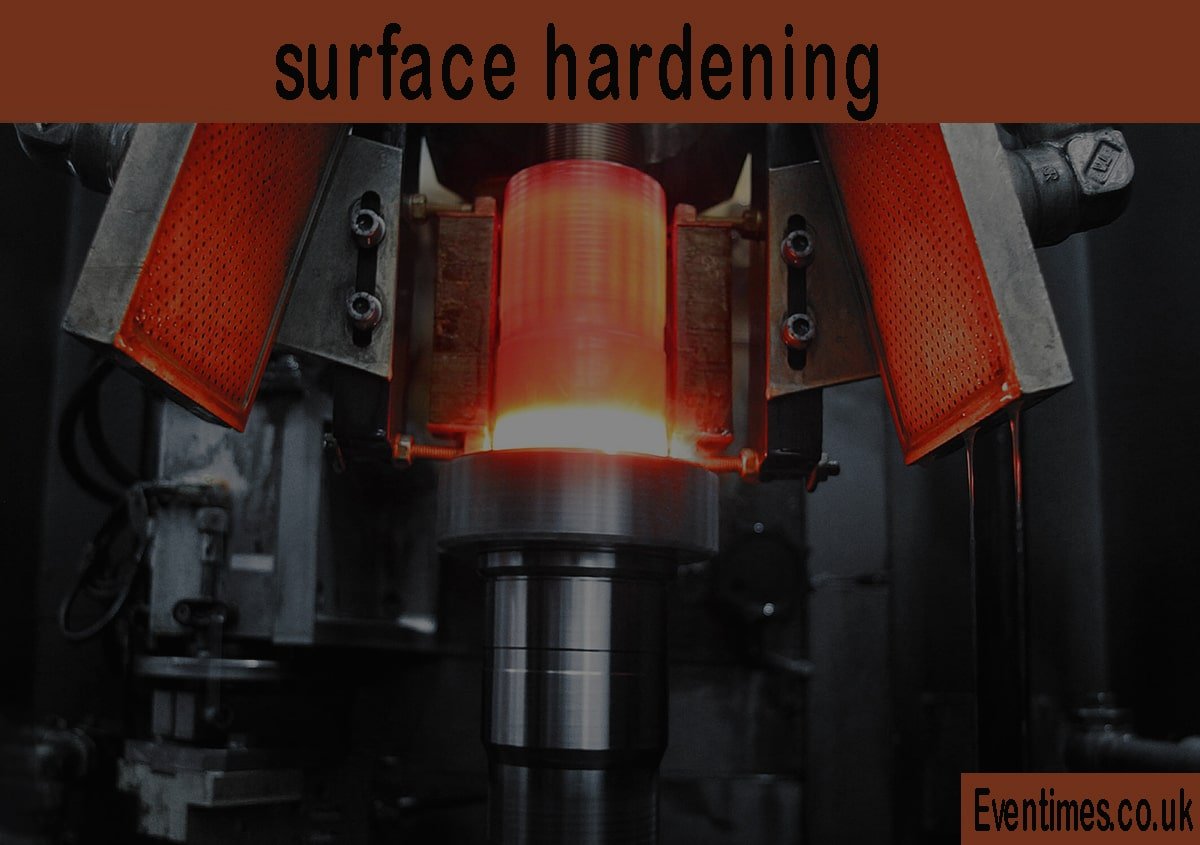
Induction hardening is a very fast and clean way to do surface hardening. Instead of a flame, we use electricity. We place a copper coil around the metal part, but not touching it. Then, we run a very strong alternating electric current through the coil. This creates a magnetic field that causes electricity to flow inside the surface of the metal part itself. This resistance heats the metal up incredibly fast—sometimes in just a few seconds!
Because it is so fast, induction hardening is perfect for assembly lines where you need to make thousands of parts a day. Once the part is hot, it gets quenched with water or a polymer spray. This method is very precise. You can control exactly how deep the heat goes and exactly which parts get hot. It is widely used for car parts like camshafts and axles where consistency is key.
Boriding: For Extreme Wear
When standard surface hardening isn’t enough, engineers might turn to boriding. This is a process where boron atoms are diffused into the surface of the metal. It creates a layer that is incredibly hard—much harder than what you get from carburizing or nitriding. Boriding is often used for tools and dies that are used to shape other metals. These tools take a lot of abuse and need extreme protection.
The process involves packing the parts in a boron-rich powder or paste and heating them up. The resulting layer is very good at resisting abrasion. Abrasion is like rubbing sandpaper against something. If your part is going to be in a very dusty or gritty environment, boriding might be the perfect solution. It also helps prevent materials from sticking to the tool, which is a nice bonus for manufacturing.
Surface Hardening vs. Through Hardening
It is important to understand the difference between surface hardening and through hardening. Through hardening means making the metal hard all the way through, from the surface to the center. While this sounds strong, it can actually make the part very brittle. If you dropped a through-hardened steel bar, it might snap.
Surface hardening avoids this risk. By keeping the core soft, the part retains “ductility,” which is a fancy word for being able to stretch or bend slightly without breaking. This combination is essential for safety. Think about the bolts holding a bridge together. You want them to be strong, but if the wind blows hard, you want them to be able to flex a tiny bit rather than snapping instantly. Surface hardening provides that safety net that through hardening often cannot.
Choosing the Right Steel
Not all metals can undergo surface hardening easily. The most common material used is steel, but the type of steel matters a lot. For methods like carburizing, you usually start with low-carbon steel. This is because you are going to add carbon later. If you start with high-carbon steel, it might get too brittle too fast.
For induction or flame hardening, you typically need “medium-carbon” steel. This steel already has enough carbon to get hard when heated and cooled; it just needs the heat treatment to activate it. Choosing the right material is step one in the engineering process. If you pick the wrong steel, the hardening process might not work, or the part might crack. Engineers spend a lot of time looking at material charts to pick the perfect alloy for the job.
Applications in Your Daily Life
You interact with items that have undergone surface hardening every single day. Let’s look at your car. The gears in the transmission, the camshaft that opens the engine valves, and the bearings in the wheels are all likely surface hardened. Without it, your car would wear out in a few thousand miles.
It is not just cars, though. The tools in your garage, like screwdrivers and hammers, often have hardened tips or faces. This keeps them from getting dented when you use them. Even things like simple padlocks utilize surface hardening on the shackle (the loop part) so that it is much harder for a thief to cut through with a hacksaw. It is a hidden technology that makes modern life reliable and safe.
Testing the Hardness
How do we know if the surface hardening worked? We test it! Engineers use special machines to press a hard object, usually a diamond or a tungsten ball, into the surface of the metal. They measure how deep the dent is. If the dent is small, the metal is hard. If the dent is big, the metal is soft.
Common scales for measuring hardness are the Rockwell C scale or the Vickers scale. You might see a specification that says “HRC 60.” This tells the manufacturer exactly how hard the surface needs to be. Regular testing ensures that every batch of parts is safe to use. If a part fails the test, the process has to be adjusted. This quality control is vital for keeping airplanes in the sky and cars on the road.
The Cost Factor
Is surface hardening expensive? It can be, but it is usually worth it. Setting up furnaces, induction coils, or flame rigs costs money. Plus, the process takes time and energy. However, if you skip it, your product might fail quickly. A cheap, unhardened gear might cost $10, but if it breaks and destroys a $10,000 engine, that is a huge problem.
Manufacturers balance the cost of the process with the value it adds. For cheap, disposable items, they might skip it. For high-quality tools or critical safety parts, surface hardening is non-negotiable. Over time, new technologies are making these processes cheaper and more energy-efficient, which is good news for everyone.
FAQs
What is the main benefit of surface hardening?
The biggest benefit is that it creates a wear-resistant surface while keeping the core tough. This prevents the part from being too brittle, so it can handle heavy use without breaking or wearing down quickly.
Can all metals be surface hardened?
No, not all metals are suitable. Steel and iron alloys are the most common. Some other metals like titanium and aluminum can be hardened using special methods, but steel is the primary material for this process.
Does surface hardening change the size of the part?
It can. Whenever you heat and cool metal, there is a risk of warping or changing size slightly. Methods like nitriding are popular because they cause very little distortion compared to other high-heat methods.
How deep does the hard layer go?
It depends on the method and the settings used. It can be very thin, like the thickness of a few sheets of paper, or much deeper, up to a quarter of an inch or more for heavy-duty parts.
Is surface hardening the same as heat treating?
Surface hardening is a type of heat treating. Heat treating is a broad category that includes making metal softer, harder, or tougher. Surface hardening specifically focuses on making just the outside layer hard.
Can you machine a part after it has been hardened?
It is very difficult. Because the surface is so hard, cutting tools struggle to shape it. Usually, parts are machined to their final shape before hardening, or they are ground with special stone wheels afterward to finish them.
Conclusion
Surface hardening is a fascinating and essential part of modern manufacturing. It is the reason our cars run smoothly, our tools last for years, and our buildings stand tall. By cleverly changing the outer layer of metal, engineers can create parts that are tough, durable, and reliable. Whether it is through adding carbon, using nitrogen, or blasting it with induction heat, the goal remains the same: to protect the part from wear while keeping it strong against shock.
Next time you pick up a high-quality wrench or drive your car, remember the science of surface hardening working silently to keep things running. It is a perfect example of how understanding materials can help us build a better, stronger world. If you are looking to manufacture parts, definitely consider if this process is right for your project.
